AlphaEta™ Encryption Overview
Introduction
Cryptography, the field of information security, is becoming increasingly important in the modern world for many reasons. Obviously it is applicable to military communications, but cryptographic techniques are also fundamental to our general economy both for business applications, such as off-site storage of all company data for disaster-recovery, as well as in applications used by individuals like on-line banking, investing, and shopping. Not surprisingly, the explosion in available communications bandwidth over the last decade has led to a corresponding growth in the transmission of sensitive information, such as financial, medical and legal records, technical designs and trade-secrets, as well as homeland security and first responder communications. In many cases, the secrecy of such data is paramount.
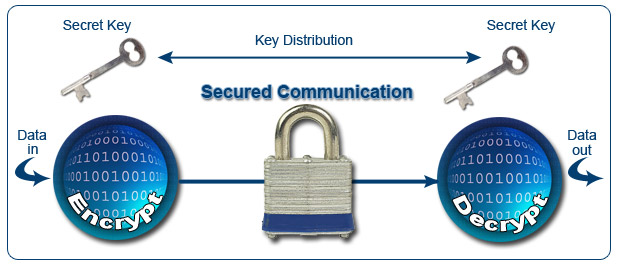
Cryptographers, who try to build systems which can securely communicate information, are forever hounded by cryptanalysts who try to break into these systems. Methods of providing security that were effective some years ago may, due to advances in computation power or analysis techniques, become vulnerable. In order to stay ‘ahead of the curve’ new, more powerful, cryptographic techniques need to be developed.
NuCrypt is developing technology that is applicable to ultrahigh security data encryption as well as key distribution. You can view key distribution as the combination to a safe and data encryption as the safe itself. If one wants to send a package over an insecure distribution system without allowing it to be tampered with, one could put the package in a safe, send the safe to the desired party, and have them open the safe with the combination. In order to do this the two parties need to securely share a secret (the combination) and have a safe which is not easy to open without the combination. These two functions are distinct, but necessary for end-to-end security.
AlphaEta™ Encryption Technology
NuCrypt’s initial product development activity is focused on a novel method of encryption that utilizes the inherent noise of light to augment the security of the best state-of-the-art cryptographic algorithms. This fundamental, and thus unavoidable, noise is called ‘quantum’ noise. Quantum noise is not a factor in radio-frequency communications such as cell phones, but comes into play at optical frequencies. One manifestation of optical noise is the fundamental ‘graininess’ of light (light grains are called photons). By utilizing a novel method of imparting data onto the light beam, we can force this noise to interfere with an eavesdropper’s observation in such a way as to make the job of attacking the secure channel much more difficult. AlphaEta encrypts optical signals directly at the physical layer- manipulating the raw optically transmitted bits. This adds a new, and qualitatively different, layer of security to optical communication systems.
While low speed randomization, such as the use of random number generators, are often used in cryptographic algorithms for security purposes, NuCrypt exploits optical noise to automatically provide high speed randomization of every single data bit. Our systems use commercially available off-the-shelf components and are compatible with current optical infrastructure, such as dense wavelength division multiplexing (DWDM). They allow for ultrahigh secure optical encryption which can protect data transmitted at very high rates over long distances. This makes our AlphaEta™ encryption method the first practical physics based ultrahigh security encryption system available.
Quantum Key Distribution (QKD)
Other important cryptographic tools include quantum key distribution (QKD) methods. QKD is not an encryption method, but instead distributes secret keys securely. Many researchers believe that QKD will one day supply keys so secure that even futuristic "quantum" computers could not be used to break into the systems. Although such properties are highly attractive, it is important to note that the optical signals in a QKD system can not be amplified, and thus are fragile and limited in reach.
One example of QKD is the "Eckhart" protocol which makes use of entangled photons. Entangled quantum systems have unique, almost magical, properties, and are a core tool for quantum operations. Entangled pairs retain an inherent connection even if they are physically separated, allowing for measurements on one state to instantly affect the other, even if they are located far apart. Contemplating the implications of this led Einstein to question the completeness of quantum mechanics. He called such an effect a "spooky action at a distance." Despite the counterintuitive implications, entangled states are real and have been used in dozens of laboratory experiments.
In particular, entangled photons are a work-horse of quantum experiments. Photons are well isolated from external interference and can propagate over long distances in standard low-loss optical fiber. Such properties have allowed entangled photons to enable a number of important scientific experiments including the first demonstration of quantum teleportation. However, in addition to scientific interest, there are also many interesting applications for entangled light, for instance in communications, cryptography, computation, calibration, and sensing. Unfortunately there are currently no commercial sources of entangled light to allow such applications to develop. NuCrypt researchers have been pioneers in the field of entangled light generation and are well positioned to address this emerging market.
Technology Overview | Concept | Implementation | Articles and Pubs | Patents | FAQs
|












