AlphaEta™ Encryption Implementation
Technical Implementation:
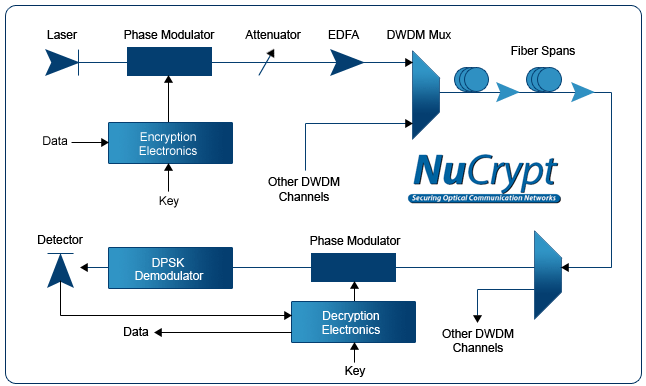
There are many ways to implement the AlphaEta™ encryption protocol. As an example, we describe here a phase-modulated implementation. After decryption, this system is essentially the same as the emerging differential phase shift keyed (DPSK) modulation method. As shown in the figure below, the encrypted channel is modulated by a phase modulator, and afterwards sent into a traditional optical multiplexer (Mux) to combine it with the other dense wavelength division multiplexers (DWDM) optical channels in the system. The encrypted channel is thus "drop-in" compatible with the available infrastructure.
Optical AlphaEta™ encryption prototype
Our AlphaEta™ line of optical encryption systems provide ultrahigh security over optical channels. As described in our Noise-Based Physical Layer Encryption section on our website we use both advanced cryptographic algorithms, and the inherent noise of light to make encryption systems that are both ultra secure and remain practical due to their use of commercially available off-the-shelf components. The technology could be packaged for use as a physical-layer line encryptor or integrated into larger optical systems.
Our prototype transceivers feature:
- Performance that is similar to standard optical communication systems
- Fast 2.5 Gb/s format independent transmission rates
- Contant-intensity M-ary phase shift keyed modulation format
- Built in forward-error correction and performance monitoring
- 500km transmission over optical fiber demonstrated
If you would like to find out more about our optical encryption methods please contact us directly. For information about our company and management team you can visit our company overview section on our website.
AlphaEta™ Product Development Photos
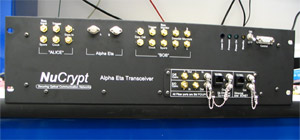
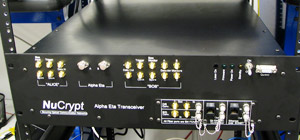
Photographs of NuCrypt's prototype encryption devices are shown below. These rack mountable transceivers are line encryption devices which accept data in a standard format at the line rate, convert it into optically encrypted data, and decrypt the optical signal back into the original data stream.
AlphaEta™ Product Questions
Please contact Gregory Kanter kanterg@nucrypt.net if you are interested in evaluating our technology. You can also fill out the form below if you have questions. Check back for more product information to be posted shortly. View our company brochure (.pdf) for more information about NuCrypt.
Back To Noise-Based Physical Layer Encryption
|